The Radiant Heat Math Every Monta Loma Eichler Buyer (and Seller) Needs to Do First
August 27, 2026
August 27, 2026
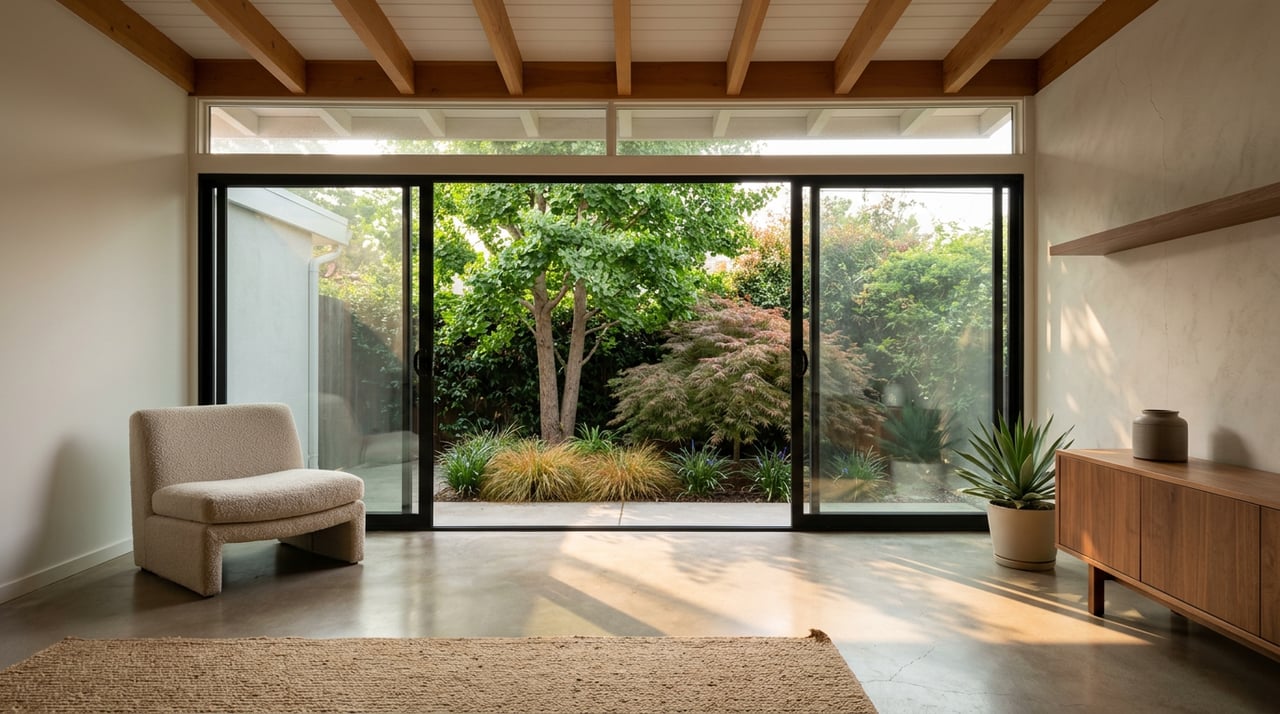
Walk a Monta Loma listing this fall and the agent will point out the exposed post-and-beam ceiling, the wall of glass facing the backyard, maybe an original brick fireplace if you're lucky. Those are the features that show up in photos. They are not the feature that should decide your offer.
The number that matters is the age of the house measured against the age of its heating system, and in Mountain View's largest Eichler tract, that math no longer works in the house's favor. These homes were approved in 1952 and built out between 1954 and 1957, which puts them at 69 to 72 years old this year. Radiant heating lines embedded in a concrete slab have a documented service life of 50 to 65 years before pinhole failures become common. Do the subtraction and you land somewhere buyers rarely expect: not a future maintenance item, but a system that has already run past its own warranty on paper.
The Monta Loma tract, originally named Fairview by Joseph Eichler, sits on Quincy Drive, Benjamin Drive, Thaddeus Drive, Dell Avenue, Emmons Drive, Nedson Court, Victory Avenue, Richard Court, Alvin Street and Thompson Avenue. Roughly 200 of these homes went up starting in 1954, designed by the architecture firm Jones & Emmons, making Fairview one of the earliest South Bay Eichler developments rather than a later, more refined one.
That early build date matters for a reason most general Eichler guides skip. Later Eichler tracts in Sunnyvale and elsewhere standardized on copper radiant lines. Fairview's original 1954 construction used steel pipe. Steel corrodes faster than copper when it's buried in concrete for decades, which means Monta Loma's radiant systems were on a shorter clock from day one, not because the neighborhood is unusual, but because it was built earlier in Eichler's production timeline, before the company's own materials evolved.
The Monta Loma Neighborhood Association runs a genuinely active community, with a Community Emergency Response Team, seasonal social events and a babysitting co-op that longtime residents point to as a real reason people stay. None of that changes what's happening under the slab.
Conventional homes hide their mechanical systems in attics and crawlspaces, so a plumber or HVAC tech has somewhere to work without touching the floor. Eichlers don't have that option. The post-and-beam structure and low-slope roof were designed around open ceilings and clerestory windows, not service access, and the radiant lines run directly through the slab the house sits on.
That means a failing line rarely announces itself the way a leak in a normal house would. There's usually no puddle. Owners typically notice a warm patch on the floor in one room, or a water bill that climbs for no obvious reason, and by the time either shows up, the leak has usually been active for a while. There's no cheap patch for a line buried in concrete. Every fix from here is a real decision, not a quick repair call.
Buyers and sellers both benefit from understanding the actual paths available once a Monta Loma radiant system starts failing, rather than treating it as one undifferentiated repair bill.
| Approach | What it involves | Typical cost range | What it tells a buyer |
|---|---|---|---|
| Monitor and patch | Pressure test existing lines, isolate failed sections, patch as issues surface | Varies widely, often several thousand dollars per incident | Buys time, but repeat failures are likely as the rest of the system ages in parallel |
| Boiler replacement only | Swap an original or aging boiler for a modern high-efficiency unit while keeping the existing slab lines | Roughly $5,000 to $10,000 | Improves efficiency and safety, but doesn't address line corrosion itself |
| Convert to ductless mini-splits | Abandon the radiant system, install wall or ceiling-mounted heat pump units room by room | Can range from the low tens of thousands into six figures depending on scope, insulation work, and whether original windows and roofing are addressed at the same time | Solves the underlying problem permanently, and adds cooling most Eichlers never had |
That top end of the range isn't hypothetical. One documented Eichler retrofit in Sunnyvale, covering new double-pane windows, a new foam roof, boiler service and solar for hot water and radiant heat, ran over $100,000. A more typical energy-focused upgrade, according to a longtime Eichler-specialist contractor, lands closer to $20,000 or under, and a standalone home energy assessment to figure out where a specific house actually stands runs about $400. The spread between those numbers is exactly why a generic inspection report isn't enough here. The right number depends entirely on which of the three paths a given house is realistically headed toward.
As of February 2026, Monta Loma's median sale price sat at $1,737,000, compared with $1,822,500 for Mountain View as a whole. That's roughly a 4.7 percent gap, and it's easy to assume it's fully explained by square footage. Fairview homes run small by current standards, mostly 1,100 to 1,400 square feet on 3-bedroom, 2-bath plans, and smaller houses sell for less almost everywhere.
Square footage is part of the story, but it isn't the whole one. These homes are still moving fast. Monta Loma's median time on market that same month was 9 days, essentially matching the citywide figure of 8. A neighborhood carrying a real, documentable systems risk shouldn't necessarily clear that quickly unless buyers already understand what they're pricing in and are comfortable doing so. The gap and the speed together suggest a market that has absorbed the age math rather than one that's ignoring it. Buyers who show up for Monta Loma specifically tend to already know what an Eichler is and what owning one at 70-plus years involves.
A standard home inspection checks the obvious things: roof surface, visible plumbing, electrical panel. None of that tells you what's happening inside a slab. Before removing contingencies on a Monta Loma Eichler, ask for:
None of this needs to be a dealbreaker. A well-documented, recently serviced system is a legitimate selling point. An undocumented one is a real unknown, and in a house where the fix touches the foundation, that unknown deserves a real answer before you're past your contingency period.
Sellers sometimes treat original radiant heat as a charming footnote in the listing description. Given the age math, it's better handled as a known quantity with a paper trail. If the boiler has been serviced on a regular schedule, say so and provide the records. If the system has already been converted to mini-splits or partially repiped, that's a genuine value-add worth pricing into the number, not just a line in the disclosures. If the original steel lines are still in place and untouched since 1954, buyers are going to find that out during inspection regardless, and pricing the home as though the system is invisible usually just moves the negotiation to escrow instead of the offer stage.
Does every home in Monta Loma have the original 1954 steel radiant system? No. Many have been repiped in copper, converted to mini-splits, or had boilers replaced over the decades. The point isn't that every house has a problem, it's that a buyer can't assume the system's condition from the outside and needs it documented rather than assumed.
Can you convert to mini-splits without losing the Eichler look? Generally yes. Wall and ceiling-mounted units can be placed without altering the roofline or adding visible ductwork, which is part of why this has become the more common conversion path compared with forcing traditional forced-air ducting into a house that was never built for it.
Is this a Monta Loma problem or a Bay Area Eichler problem? The underlying radiant heat aging issue applies to Eichlers generally. Monta Loma's earlier 1954 build date and original steel piping, rather than the copper used in some later tracts, means the clock on this particular tract started running sooner than it did in neighborhoods built even a few years later.
Whether you're weighing an offer on a Fairview original or pricing one to sell, the radiant system deserves the same attention as the roof and the foundation, because at this age, it effectively is part of the foundation conversation. If you want a second set of eyes on what a specific Monta Loma property's systems history actually says before you write an offer or set a list price, the Taylor Lambert Group can walk through it with you. Get your free home valuation and we'll factor in what's actually under the slab, not just what's on the flyer.
Stay up to date on the latest real estate trends.


Housing Market Updates!
Etiam non quam lacus suspendisse faucibus interdum. Orci ac auctor augue mauris augue neque. Bibendum at varius vel pharetra. Viverra orci sagittis eu volutpat.